Shells, Stones or Sea Glass: What Makes a Good Beachcombing Find?
Beachcombing finds need not go home with you. Compare shells, stones and sea glass by shape, texture and colour, then enjoy each one where it rests.
The common beachcombing mistake is to judge a find by whether it is worth taking home. That turns a quiet search into collecting, and can leave a tideline picked over without making the walk more memorable. A good beachcombing find is one that rewards a closer look: a shell’s curve, a stone’s grain or a glint of glass caught between pebbles.
What makes a good beachcombing find?
Start with the question the object raises, not its rarity or resale value. Look at how its shape catches the light, how its surface changes from one edge to another, and how it sits among the sand, weed and shingle around it.
You can enjoy that attention without picking anything up. Pause beside the find, shift your viewpoint, and notice what looks different from above or at a low angle. If the surface is wet, wait for a wave to draw back; the sheen may reveal colour or texture that was less apparent a moment earlier.
Keep the object in its setting. A pale shell against dark shingle, for instance, may be more striking because of that contrast than it would be in a pocket.
How do shells reward a closer look?
Shells offer an easy lesson in shape. A spiral can draw the eye towards its centre, while a broken fragment may show a scalloped edge or a fine change in thickness. Look for ridges, smooth patches and the way the opening narrows or flares.
Colour is not the only clue. A shell may appear chalky when dry, then take on a muted gloss beside damp sand. Notice whether the pattern follows the curve, crosses it, or fades towards an edge. Those small details make a shell interesting without needing to identify its species.
Leave shells where they lie, particularly if they may still shelter a living creature. A shell occupied by a small animal is part of the living shore, not a souvenir. Admire it from a respectful distance and avoid turning it over or carrying it away.
Try tracing the shell’s outline in the air with a finger rather than touching it. That gives your eye a simple route to follow.
What can stones show you?
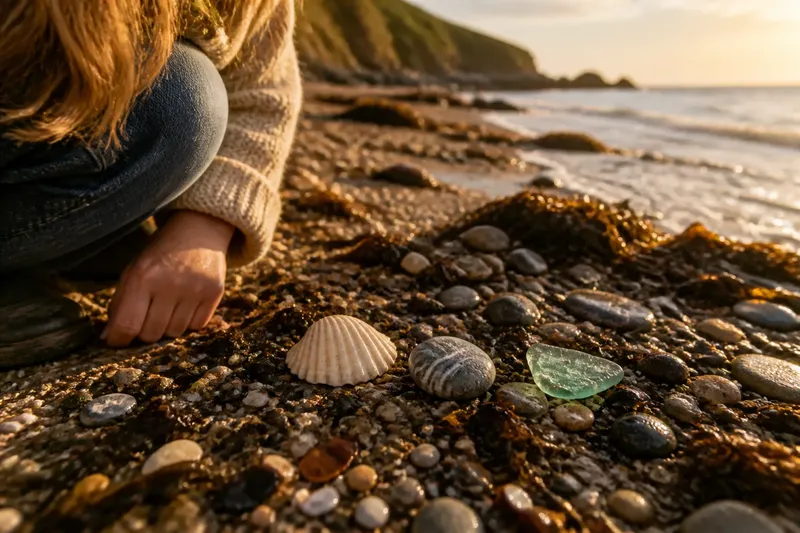
Stones stand out through contrast and texture. One may be smoothly rounded beside angular fragments; another may carry pale veins, dark speckles or layers that run across its face. Compare neighbouring stones instead of treating each one as a prize in isolation.
Notice the outline first. A flat stone may sit like a small shelf, while a rounded one seems to roll into the shingle around it. Then look for surface changes: a weathered edge, a shallow hollow or a stripe of contrasting colour. Avoid scratching, chipping or knocking stones together to expose a fresh face.
A stone’s surroundings can be part of its appeal. A single dark pebble among pale shingle may draw the eye; placed elsewhere, it might disappear. Leave it in place and step back to see how the whole patch of beach frames it.
Why does sea glass catch the eye?
Sea glass is often noticed for its softened edges and frosted surface. Its colour may be more vivid against wet sand than dry, and a curved fragment can hold a small highlight as the light shifts. Look without assuming every bright shard is sea glass: clear debris can have sharp edges.
Do not handle an uncertain piece. Broken glass can cut, and a wave may conceal sharp fragments nearby. Observe from where you are standing, and give the area space if the object looks hazardous. If something poses an immediate risk to other beach users, follow local guidance for reporting it rather than trying to remove it yourself.
When the glass is clearly rounded and safely visible, its appeal can still be appreciated at a distance. Compare its frosted face with the smoother, darker surface of a wet pebble beside it.
How can you compare finds without collecting them?
Use a simple sequence: look, compare, then leave the scene as you found it. You might notice a shell’s repeating ridges, compare them with a stone’s irregular grain, and then spot how a glass fragment changes the colour pattern around it. There is no need to choose a winner.
Say you come across a pale shell, a striped pebble and a greenish glass fragment on a stretch of shingle. You pause at a safe distance, notice that the shell’s curve echoes the rounded stone, and see the glass brighten against the darker ground. The expected result is a clearer memory of the contrasts, while all three objects remain where they were.
If you want a record, use a small notebook or make a quick phone photograph that includes the surrounding shingle for context. Note the light, tide line or nearby seaweed rather than trying to catalogue every object. Check your screen briefly, then return your attention to the beach.
What should you notice before moving on?
Is every shell empty?
No. A shell can still house a living animal, even if it looks weathered or partly buried. Leave it untouched if you cannot tell.
Can you pick up sea glass safely?
Not every fragment is rounded, and loose glass can have sharp edges. Enjoy it visually and avoid handling pieces that are chipped, unclear or close to other debris.
What if a find looks unusual?
Look for its shape, surface and setting without disturbing it. If it may be a living creature or something hazardous, keep your distance and seek local advice where needed.
How can you remember a find without taking it?
Make a brief note of its colour, outline and position among nearby materials. A photograph that shows the wider patch can preserve the contrast that made it stand out.
How do you leave the beach ready for the next visitor?
Before walking on, check that you have not shifted stones, turned over shells or left anything behind. Keep your hands free, watch the tide and footing, and give wildlife and other beach users room. If you have taken a photograph, avoid sharing the location of a fragile or sensitive spot.
The best beachcombing find may be a detail you would have walked past: a shell’s fine rim, a stone’s unexpected stripe or a muted flash of glass. Look closely, let the setting do some of the work, and leave each object where the tide and shore have placed it.